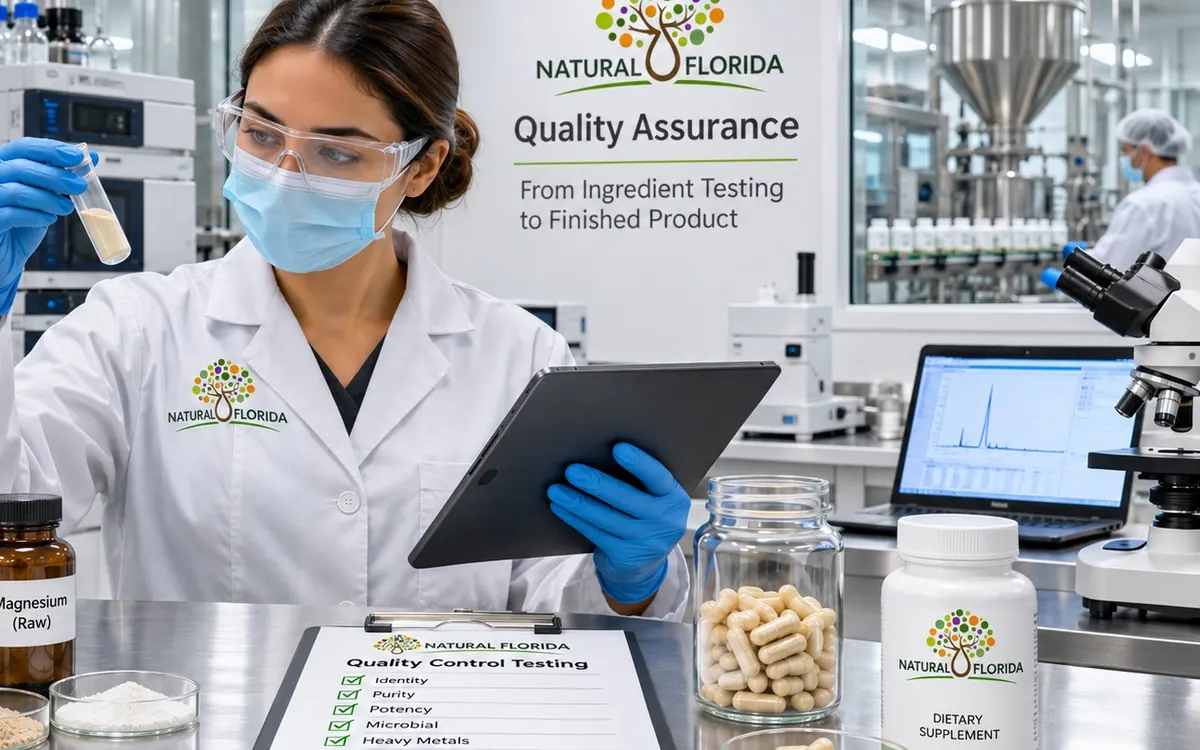


A certificate of analysis (COA) for supplements is a document that reports the test results for one specific lot against its specification. To read it, check four things: that the product name and lot number match your bottles, that each test has a clear specification and a result, that every result falls within its limit, and that the report is dated, signed and tied to a named lab or quality unit. A COA is only as useful as the specification behind it, so always compare it with the agreed spec, not just the word "pass".
What a COA is and why it matters
Under the FDA cGMP rule for dietary supplements, 21 CFR Part 111, each finished batch must meet its specification for identity, purity, strength and composition, and limits on contaminants, before it is released. The COA is how those results are reported to you. Brands use COAs to:
- Confirm a lot meets the agreed specification before selling it
- Answer customer, retailer and marketplace questions
- Investigate complaints by lot number
- Keep records that show they know what they are selling
COA supplements documents also exist for raw ingredients: suppliers send them with each ingredient lot, and manufacturers use them alongside their own testing.
Anatomy of a supplement COA
| Section | What it shows | What to check |
|---|---|---|
| Header | Company or lab name, address, document title | That it is from your manufacturer or a named lab |
| Product information | Product name, lot or batch number, manufacture date, best-by date | Exact match with your label and bottles |
| Test | Name of each test, such as identity, vitamin C content, lead | All tests in your specification are listed |
| Method | Test method or reference | A method is given, not just "in house" with no detail |
| Specification | The limit or range the result must meet | Matches your agreed specification |
| Result | The measured value | A number or clear outcome, with units |
| Conclusion | Pass or fail, conforms or does not conform | Consistent with the results |
| Approval | Date, signature, name or title of the approver | Present and dated after testing |
Reading each section
Product and lot information
Start here. The lot number on the COA must match the lot number printed on your bottles. A COA for a different lot, or a generic COA with no lot number, tells you nothing about the product you are holding.
Identity
Identity results usually read "conforms" or "positive", with the method named. For botanicals, look for the species and plant part where relevant. If identity is missing from a finished product COA, ask how identity was confirmed for the ingredients; Part 111 requires identity verification of every dietary ingredient before use.
Strength or potency
Strength results compare the measured amount with the label claim. They may be shown as an amount per serving, per capsule, or as a percentage of label claim. Check the units carefully: milligrams per capsule and milligrams per serving are different if the serving is two capsules. A result above 100% of label claim is common because of overages added to cover loss over shelf life.
Contaminants
Heavy metals are usually reported for lead, arsenic, cadmium and mercury, often in parts per million or micrograms per serving. Microbial results show counts for total aerobic bacteria and yeast and mold, and "absent" or "negative" for specified organisms such as E. coli and Salmonella. Check that each limit is stated, not just the result.
Physical tests
For capsules and tablets you may see average weight, weight variation, disintegration time and, for tablets, hardness. These show that the product will deliver the dose consistently.
Red flags on a certificate of analysis
- No lot number, or a lot number that does not match your product
- Tests listed without specifications or limits
- Results reported only as "pass" with no values where values are expected
- Units missing or inconsistent with the label
- Tests in your specification missing from the COA
- No method references at all
- No date or approval, or a date before the product was made
- Identical results across many different lots, which can suggest copied data
- A strength result below the label claim for a product inside its shelf life
If you see any of these, ask your manufacturer for an explanation before you sell the lot.
Specification first, COA second
A COA can only be checked against something. Before your first production run, agree a written finished product specification with your manufacturer that lists:
- Each test, its method and its limit
- Which ingredients are tested for strength, and how
- Contaminant limits per daily serving
- Physical parameters: weight, disintegration, appearance
- Who performs each test, in house or at an outside lab
Then every COA you receive can be read line by line against that document. Our guide to supplement testing explains the tests that usually belong in a specification.
In-house COA vs third-party lab report
A manufacturer's COA usually summarizes results from its own lab and from outside labs it uses. A third-party lab report comes directly from an independent lab for a sample you or the manufacturer sent. Both are valid; they serve different purposes. Some marketplaces, such as Amazon, may ask for testing by approved independent organizations; see what your manufacturer must provide for Amazon.
Ingredient COAs vs finished product COAs
Suppliers send a COA with each ingredient lot. It tells the manufacturer what the supplier found, but under Part 111 the manufacturer must still verify the identity of every dietary ingredient itself, and may rely on supplier results for other specifications only after qualifying the supplier. The finished product COA is the one that matters most to you: it covers the product in your bottle, after blending, encapsulation or compression, and packaging.
How to store and use COAs
- File by lot number. Keep COAs with the label version and shipping records for each lot.
- Keep them for the life of the product and beyond. Part 111 sets record retention periods for manufacturers; brand owners benefit from keeping their own copies for at least as long.
- Use them in customer service. When a customer asks about a bottle, the lot number leads you straight to its results.
- Watch trends. Compare strength results over several lots. Drifting results deserve a conversation even when all are in specification.
Questions to ask your manufacturer about COAs
- Will I receive a COA for every finished lot, and how soon after production?
- Which tests are done in house, and which by outside labs?
- Can you show me a sample COA before I order?
- What happens if a result is out of specification?
- Can I get supplier COAs for key ingredients if a retailer asks?
For the wider picture of what a good manufacturer documents, read what cGMP means for dietary supplements. Public standards for many tests come from bodies such as USP.
COAs at Natural Florida
Natural Florida provides documentation with every order and a certificate of analysis on request for each lot of capsules and tablets we make. Results come from identity checks of incoming ingredients and testing of finished batches before release, under cGMP practices under 21 CFR Part 111, and are tied to the lot number on your bottles. If your retailer or marketplace needs COAs or facility documents, tell us what they ask for and we help you prepare it. Read more on our quality and compliance page, see what documentation comes with each batch, or ask a question through the quote form. We reply within one business day.
Frequently asked questions
What is a certificate of analysis for supplements?
A document that reports test results for a specific lot of a supplement or ingredient against its specification, usually covering identity, strength, contaminants and physical tests.
Should every supplement batch have a COA?
Every finished batch must meet its specification before release under 21 CFR Part 111, and most manufacturers document this in a COA for each lot. Ask for one with every order.
Why is the strength result above 100% on my COA?
Manufacturers often add a small overage at production so the product stays at or above the labeled amount through its shelf life. Results within the specification range are normal.
Can I share my COA with customers?
Many brands do, often by lot number on their website. Check with your manufacturer first and remove any confidential supplier details if needed.