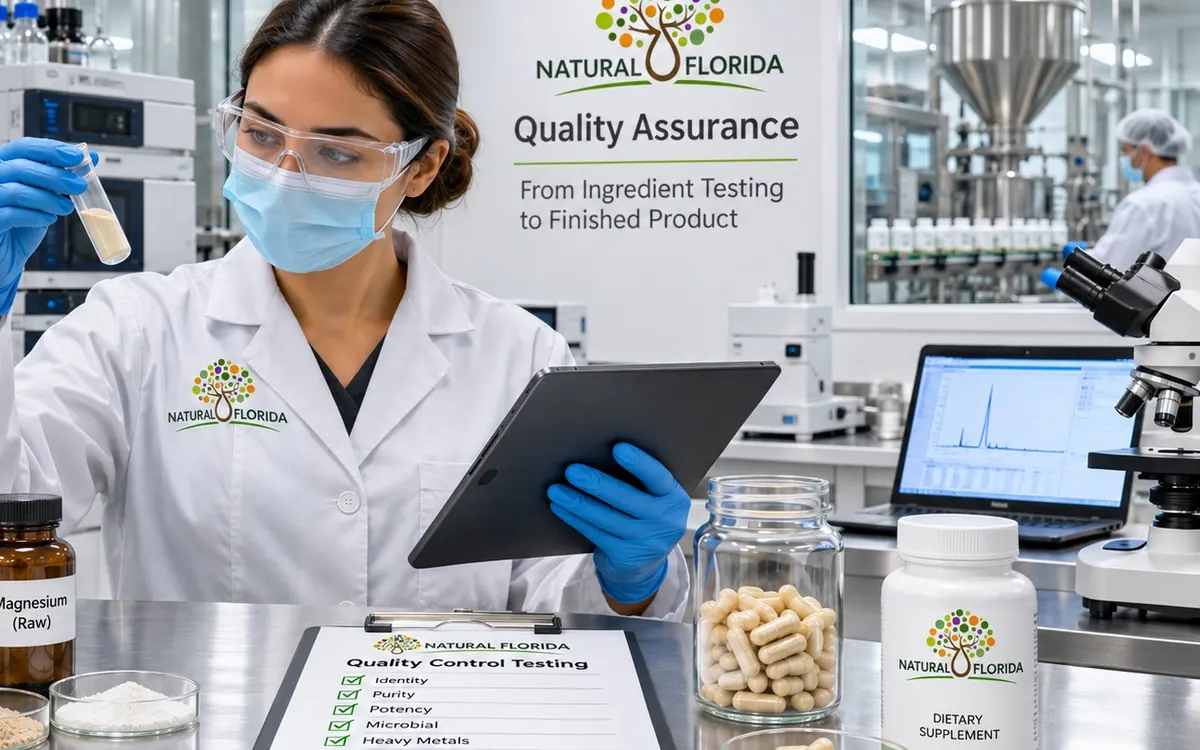


cGMP for dietary supplements means following the FDA's current good manufacturing practice rule for dietary supplements, 21 CFR Part 111. It requires GMP supplement manufacturers to have written procedures, trained staff, clean facilities and equipment, specifications for every ingredient and finished product, identity testing of dietary ingredients, a master manufacturing record for each product, a batch record for every batch, and a quality unit that reviews and releases each batch. Its goal is that every supplement contains what the label says, at the strength stated, without contamination.
What 21 CFR Part 111 is
Part 111 is the federal regulation, issued by the FDA in 2007, that sets minimum cGMP requirements for anyone who manufactures, packages, labels or holds dietary supplements sold in the US. It applies to domestic and foreign companies that sell into the US, and to contract manufacturers and brand owners alike. You can read the full text on eCFR: 21 CFR Part 111, and the FDA summarizes it on its cGMP page for dietary supplements.
The "c" in cGMP stands for "current": companies are expected to use practices that are up to date, not just the bare minimum written years ago.
What the rule covers, subpart by subpart
| Area of Part 111 | What it requires in practice |
|---|---|
| Personnel | Qualified, trained staff; hygiene; supervisors who know cGMP |
| Physical plant and grounds | Clean, maintained buildings designed to prevent mix-ups and contamination |
| Equipment and utensils | Suitable, clean, calibrated equipment with maintenance records |
| Production and process control | A written system covering every step from receiving to release |
| Quality control | A quality unit that approves specifications, reviews records and releases or rejects |
| Components, packaging and labels | Specifications for incoming materials; identity testing of dietary ingredients |
| Master manufacturing record | A written recipe and instructions for each formula and batch size |
| Batch production record | A complete record of what was done for each batch |
| Laboratory operations | Appropriate test methods, controls and records |
| Manufacturing operations | Steps to prevent contamination and ensure correct ingredients and amounts |
| Packaging and labeling | Controls so the right label goes on the right product, with lot numbers |
| Holding and distribution | Proper storage conditions for materials and finished product |
| Returns and complaints | Procedures to review returned product and investigate complaints |
| Records | Keeping required records for a set period and making them available |
The core ideas behind quality supplement manufacturing
Specifications
A specification is a written standard. Part 111 expects specifications for components (ingredients and packaging) and for the finished product, covering identity, purity, strength and composition, and limits on contaminants. Everything else in the rule is about meeting and proving those specifications.
Identity testing of dietary ingredients
Before a dietary ingredient can be used, the manufacturer must conduct at least one appropriate test or examination to verify its identity. This is one of the most important protections in the rule: it stops the wrong botanical, or a substituted material, from reaching your capsules. Other components can be accepted on a supplier's certificate of analysis only if the manufacturer has qualified that supplier and confirms the results periodically.
Master manufacturing and batch records
The master manufacturing record (MMR) is the approved recipe and set of instructions for a product. Each batch gets a batch production record that documents the actual ingredients and lots used, weights, equipment, in-process checks, packaging, labeling and results. If something goes wrong later, the batch record shows exactly what happened.
Quality control review and release
A quality unit, separate from production in its responsibilities, reviews the records and test results and decides whether each batch can be released. Product that does not meet specification must not be released unless the deviation is investigated and properly resolved under the rule.
Reserve samples and records
Manufacturers keep reserve samples of each batch and keep required records for a set time beyond the shelf life or distribution date. These allow problems to be investigated after a product is on the market.
What cGMP does not mean
Understanding the limits of the rule protects you from misleading marketing:
- It is not FDA approval of the product. The FDA does not approve dietary supplements before they are sold. See the FDA's dietary supplements overview.
- It is not a certificate the FDA hands out. The FDA inspects facilities and can issue observations or warning letters, but it does not issue cGMP certificates to supplement companies.
- It does not make claims true. cGMP ensures a product matches its specification. Whether a claim about the product is truthful is a separate question, covered by FDA labeling rules and the FTC Health Products Compliance Guidance.
Is there such a thing as GMP certification?
You will see the phrase "GMP certification" in marketing. It usually refers to a private third-party audit program, not to the FDA. These programs can be valuable: an independent auditor checks the facility against cGMP and the program's own standards. But they vary in scope and depth. If a manufacturer mentions one, ask:
- Which organization ran the audit, and against which standard?
- When was the last audit, and when is the next?
- Does it cover the specific facility that will make your product?
- Can you see the audit summary or the certificate scope?
- How were any findings closed?
A program badge is a starting point. The real proof is in the documents: specifications, identity tests, batch records and release decisions.
Who is responsible when manufacturing is outsourced
If your brand's name is on the label, you are responsible for the product even if a contract manufacturer makes it. The FDA expects a brand owner that outsources to know that the product is made under cGMP and to keep control over it, for example by setting or approving specifications and reviewing results. A written quality agreement sets out who does what. Read more in supplement contract manufacturing explained.
How to check GMP supplement manufacturers
Ask for evidence, not adjectives:
- Walk me through receiving. How are ingredients quarantined, sampled and tested for identity?
- Show me a blank batch record. Does it cover weights, checks, packaging and sign-offs?
- Who releases batches? Is there a quality unit with clear authority?
- What do you test on finished product? Against which specification?
- What is your inspection history? Ask about FDA inspections and how observations were handled.
- Can I visit? A good manufacturer welcomes visits by appointment.
- Will I get a certificate of analysis? See how to read a COA.
More questions are in how to choose a supplement manufacturer.
Related rules brand owners should know
- Facility registration. Facilities that manufacture, process, pack or hold food, including dietary supplements, for US consumption must register with the FDA; see food facility registration.
- Labeling. Supplement labels follow 21 CFR Part 101, including 101.36 for the Supplement Facts panel.
- New dietary ingredients. Some ingredients need a premarket notification; see new dietary ingredients.
- Adverse events. Serious adverse events reported to you must be submitted to the FDA, and your label needs a domestic address or phone number.
- Public standards. Many specifications refer to compendial methods and standards, such as those published by USP for dietary supplements.
cGMP at Natural Florida
Natural Florida manufactures capsules and tablets in Hollywood, Florida, following cGMP practices under 21 CFR Part 111. Every run follows written master manufacturing records and batch records; incoming ingredients are checked for identity; in-process checks cover fill weights for capsules and weight, hardness, thickness and disintegration for tablets; finished batches are tested before release; and you get documentation with every order, with a certificate of analysis on request. Read the details on our quality and compliance page, see how we test and release each batch, or visit us by appointment. To discuss a project, use the quote form; we reply within one business day.
Frequently asked questions
What does cGMP mean for supplements?
It means following the FDA's current good manufacturing practice rule for dietary supplements, 21 CFR Part 111, which covers staff, facilities, equipment, specifications, testing, records and quality control release.
Does the FDA certify supplement manufacturers?
No. The FDA inspects facilities and enforces Part 111, but it does not issue cGMP certificates to supplement manufacturers or approve supplements before sale. Third-party audit programs are private.
Does Part 111 require testing of every ingredient?
Every dietary ingredient must have its identity verified by at least one appropriate test or examination before use. Other components must meet specifications, which can sometimes be confirmed through a qualified supplier's certificate of analysis.
Does cGMP apply to the brand owner or only the manufacturer?
Both. Each company must follow Part 111 for the operations it performs, and a brand owner that outsources manufacturing remains responsible for the product it puts on the market.
Is GMP the same as cGMP?
In everyday use, yes. The "c" stands for "current" and signals that practices must be kept up to date, not frozen at the minimum.
Sources and further reading
- ecfr.gov: eCFR: 21 CFR Part 111
- fda.gov: cGMP page for dietary supplements
- fda.gov: FDA's dietary supplements overview
- ftc.gov: FTC Health Products Compliance Guidance
- fda.gov: food facility registration
- ecfr.gov: 101.36 for the Supplement Facts panel
- fda.gov: new dietary ingredients
- usp.org: USP for dietary supplements