
Custom supplement formulation is the process of turning a product idea into a formula that can be manufactured, labeled and sold. It starts with a brief: the goal of the product, the customer and the target cost per bottle. A formulator then chooses ingredients, forms and doses, checks that they fit and work together in a capsule or tablet, estimates the cost per unit and drafts the Supplement Facts panel. Samples are made for your approval, and only then does the formula scale to full production.
When custom formulation makes sense
A custom formula is worth the extra time when:
- No existing private label formula matches what your customers want
- You need a clear point of difference in a crowded category
- You want to own a formula others cannot buy from a catalog
- You have specific ingredient forms, sources or doses in mind
- You are improving a best seller based on customer feedback
If speed and a low first order matter more, start with private label and adjust it; see private label vs white label vs custom supplements.
The custom formulation process
| Stage | What happens | Your input |
|---|---|---|
| 1. Brief | Goal, customer, format preference, target price, channels | Write it down; share examples you admire |
| 2. Concept | Formulator proposes ingredients, forms and doses | Feedback on direction and budget |
| 3. Feasibility | Check fit per serving, compatibility, availability, legality | Decide on trade-offs |
| 4. Cost estimate | Cost per unit at your quantities | Confirm or adjust the target |
| 5. Supplement Facts draft | Label panel and other ingredients drafted | Review wording and claims |
| 6. Samples | Small trial lot made | Test look, smell, size, taste; approve or request changes |
| 7. Specification | Finished product specification and records written | Approve the specification |
| 8. Scale-up | First production run | Approve final label; plan the launch |
Step 1: write a strong brief
The brief shapes everything. Include:
- What the product is for, in structure/function terms, and who it is for
- Capsule or tablet preference, and why
- Ingredients you want, and any you want to avoid
- Vegan, allergen-free or other requirements
- Target serving: how many capsules or tablets a day, at most
- Target retail price and cost per bottle
- Sales channels: your site, Amazon, retail, practitioners
- First-run quantity and expected monthly volume
A competitor's product you admire is a useful reference, but the aim is to build something better or different, not a copy.
Step 2: ingredients, forms and doses
Choosing ingredients
Each ingredient should earn its place. A formula with five ingredients at meaningful doses is usually better, cheaper and easier to explain than one with twenty at token amounts. Check that each ingredient is a lawful dietary ingredient at the intended use. Ingredients not marketed in the US before October 15, 1994 may be new dietary ingredients that need a notification to the FDA; see the FDA's new dietary ingredient guidance.
Choosing forms
The same nutrient or botanical comes in different forms: salts and chelates for minerals, extracts standardized to different markers for botanicals, different forms of vitamins. Forms differ in weight, cost, stability and how much space they take in a capsule.
Setting doses
Doses come from the evidence you rely on for your claims, safety considerations and what fits in the format. Keep a file of the sources behind each dose. That file is also the basis for supporting your marketing claims later.
Step 3: feasibility in the chosen format
A formula on paper still has to run on machines. The formulator checks:
- Fit. Total weight per serving divided across a reasonable number of capsules or tablets. The capsule size chart helps estimate this.
- Compatibility. Some ingredients react with each other or with moisture.
- Flow and compression. Whether the blend fills capsules evenly or compresses into sound tablets.
- Stability. Whether amounts will hold through the shelf life, and what overages are needed.
- Taste and odor. Strong botanicals may need opaque capsules or a coated tablet.
If the dose does not fit, the options are a more concentrated form, fewer ingredients, more units per serving, or a different format; see capsules vs tablets.
Step 4: cost per unit
A cost estimate early in the process stops surprises. The largest share usually comes from two or three ingredients. If the estimate is over target, a formulator can suggest alternatives: a different form, a slightly lower dose of a costly ingredient, or a capsule size that reduces units per serving. Our guide to supplement manufacturing cost explains the drivers.
Step 5: Supplement Facts and claims
The formula becomes a label. Dietary ingredients with Daily Values are listed first in a set order, followed by other dietary ingredients, with proprietary blends listed by total weight if used. The panel must follow 21 CFR 101.36. Our guide to the Supplement Facts panel explains each line.
At the same stage, check what you plan to say. Dietary supplements may carry structure/function statements, not disease claims, and those statements must be truthful and supported. Read structure/function claims and the FTC's Health Products Compliance Guidance before you write marketing copy.
Step 6: samples
Samples let you hold the product before committing. Check:
- Size and ease of swallowing
- Color and appearance through a clear shell or the coating
- Smell when the bottle is opened
- Taste, if the capsule is opened or the tablet is chewed accidentally
- Count per bottle and how full the bottle looks
Make changes at this stage, not after your first order. Each change after approval means new samples and records.
Step 7 and 8: specification and scale-up
Once you approve the samples, the manufacturer writes the finished product specification and the master manufacturing record required by the FDA cGMP rule, 21 CFR Part 111. The first production run follows them exactly, with identity testing of ingredients, in-process checks and finished product testing before release.
Who owns a custom formula?
Agree in writing before development starts. Many brands own the formula they paid to develop, but terms vary. Put ownership, confidentiality and what documents you receive if you move production into your agreement.
Common formulation mistakes
- Too many ingredients at tiny doses. It looks impressive and does little.
- Ignoring fit. Six capsules a day rarely sells well.
- Writing claims first. Let the evidence shape the claims, not the other way round.
- Skipping samples. A formula that looks right on paper can smell, taste or look wrong.
- Late changes. Every change after approval costs time.
Custom formulation at Natural Florida
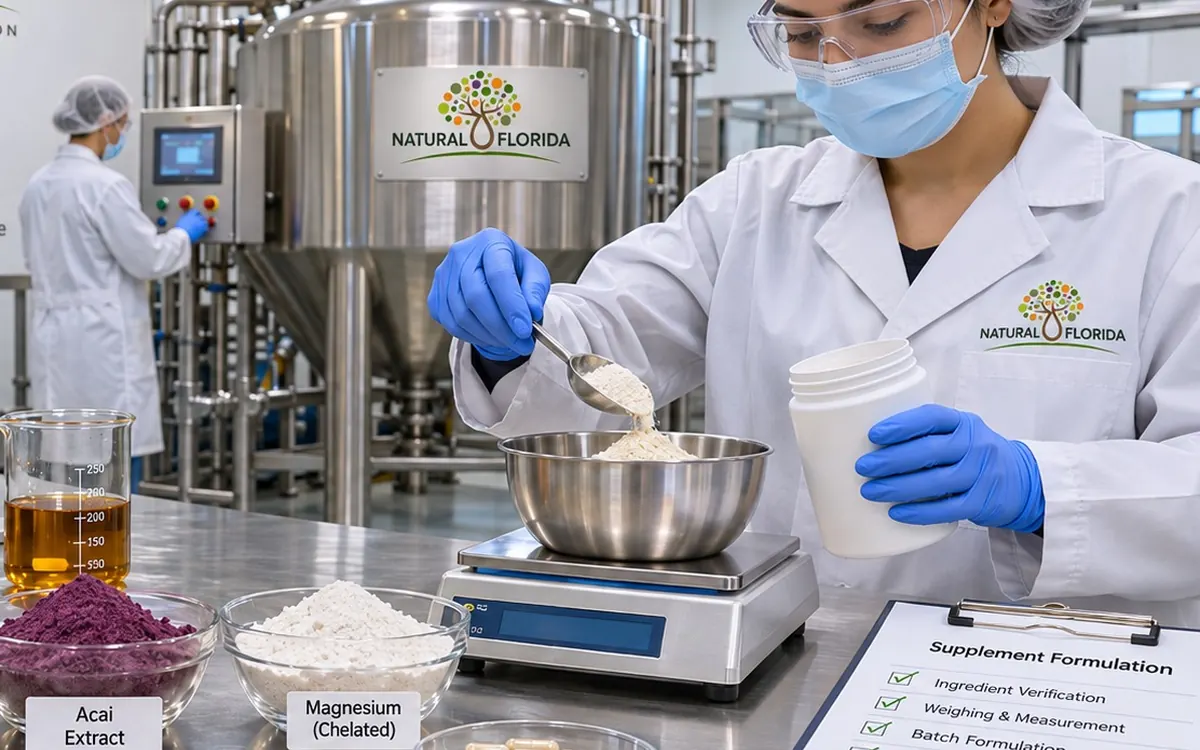
Natural Florida's formulation team turns ideas into formulas that can be manufactured, labeled and sold. Bring an idea, a product you admire or a list of ingredients; we start with your goal, your audience and your target cost per bottle, then choose ingredients and doses, check that they work together in a capsule or tablet, give you a cost per unit estimate and prepare a Supplement Facts draft. You receive samples to test and approve before production, and we help keep your label and marketing on the right side of FDA and FTC rules. Production follows cGMP practices under 21 CFR Part 111. See our custom supplement formulation service, read how our formulation process works, or share your idea through the quote form. We reply within one business day.
Frequently asked questions
What is custom supplement formulation?
The process of turning a product idea into a formula that can be manufactured, labeled and sold, covering ingredient and dose selection, format, cost, label draft and samples.
Do I need a formula before contacting a manufacturer?
No. Many manufacturers, including custom supplement manufacturers with formulation teams, can start from an idea or a product you admire and build the formula with you.
Who owns a custom supplement formula?
It depends on the agreement. Many brands own the formula they paid to develop. Agree on ownership and confidentiality in writing before development starts.
Can I change a custom formula after samples?
Yes, before approval. Changes after you approve samples usually mean new samples, an updated specification and possibly a new label, which delays production.