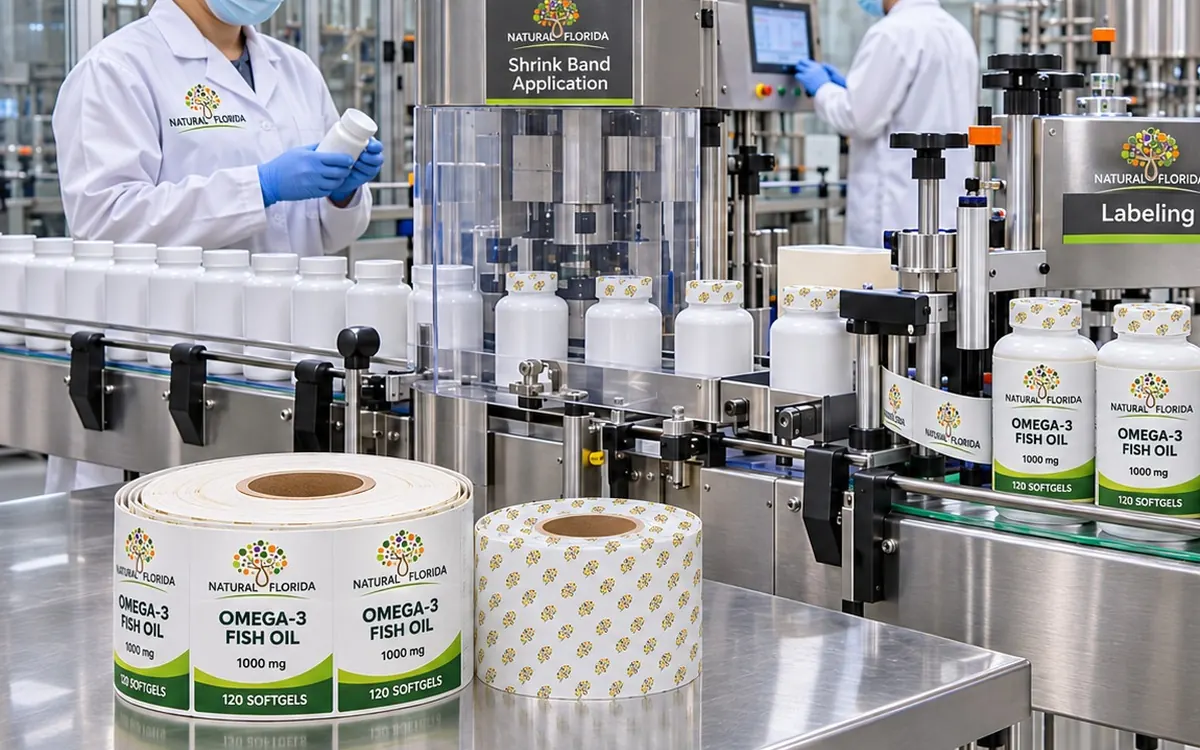

Good supplement packaging protects the product, meets the label rules and sells on the shelf. For capsules and tablets, the standard setup is a bottle in HDPE, PET or amber glass sized to the count, a child-resistant or continuous-thread cap, an induction seal under the cap for tamper evidence and moisture protection, a desiccant if the formula is sensitive to humidity, a pressure-sensitive label or full shrink sleeve, and a lot number with a best-by date. Choose components that fit your formula, your channel and your budget, and confirm them with your manufacturer before printing labels.
What packaging has to do
Packaging does four jobs at once:
- Protect capsules and tablets from moisture, oxygen, light and physical damage through the whole shelf life.
- Prove the product has not been opened, with tamper-evident features.
- Inform with a compliant label: identity, net quantity, Supplement Facts, other ingredients, name and place of business, and any required warnings. See supplement label requirements.
- Sell with a design and format that stands out and fits the channel, from a retail shelf to an Amazon listing photo.
Under the FDA cGMP rule, 21 CFR Part 111, packaging and labeling operations must be controlled and documented, and packaging components must be suitable for their intended use and checked before use.
Bottles: HDPE, PET or glass
| Material | Look | Strengths | Watch-outs | Common use |
|---|---|---|---|---|
| HDPE (high-density polyethylene) | Opaque, usually white | Good moisture barrier, light, durable, cost-effective | Not see-through | The default for most capsules and tablets |
| PET (polyethylene terephthalate) | Clear or amber, glossy | Shows the product, premium look, light | Lower moisture barrier than HDPE; clear PET lets in light | Brands that want the product visible |
| Amber glass | Brown, heavy | Excellent barrier, blocks much UV light, premium feel | Heavier, breakable, higher shipping cost | Premium and light-sensitive formulas |
Supplement bottle manufacturers offer stock shapes in standard sizes. The most common are packer (round) bottles and Boston round bottles. Size is described by volume (for example in cc or ounces) and neck finish (for example 38-400 or 45-400). The neck finish must match your cap.
Choosing the bottle size
The bottle should hold your count with a little headspace for the desiccant and cotton if used, without looking half empty. As a starting point, ask your manufacturer to fill a sample bottle with your actual capsules or tablets. Capsule size and tablet shape change how much space a count needs; see the capsule size chart.
Caps and closures
- Continuous thread (CT) caps screw on and off. Simple and widely used.
- Child-resistant (CR) caps need a push-and-turn action. Required for some products, such as many iron-containing supplements under the Poison Prevention Packaging Act, and preferred by many brands as a safety feature.
- Liners inside the cap create the seal. Induction liners are the most common for supplements.
- Color and finish can match your brand: white, black and metallic finishes are common stock options.
Always order caps that match the bottle's neck finish, and test a sample of the full pack before committing.
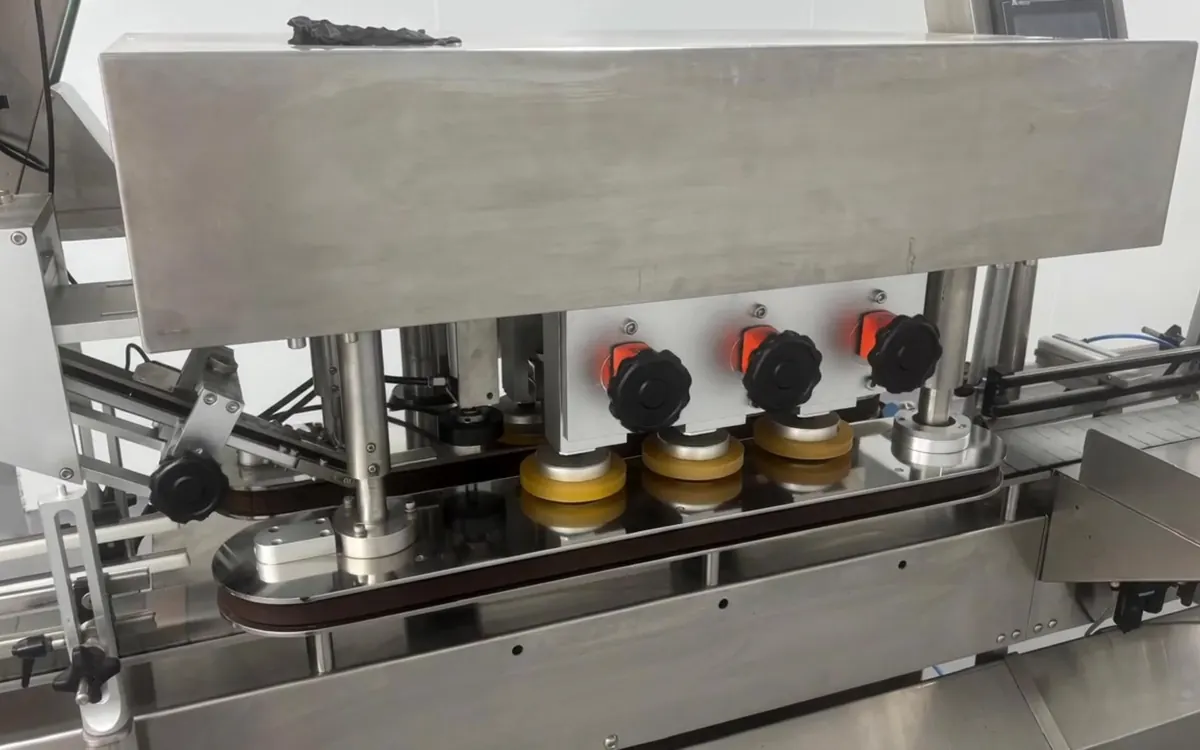
Induction seals: tamper evidence and freshness
An induction seal is a foil membrane bonded to the bottle rim by an induction sealer after capping. It provides tamper evidence and adds a strong barrier against moisture and oxygen. Pair it with a statement such as "Do not use if seal under cap is broken or missing."
Check during production:
- Seal fully bonded around the rim, no gaps or wrinkles
- Seal peels cleanly for the customer
- Cap torque correct, neither loose nor over-tight
- Tamper statement on the label
Desiccants and cotton
Many capsules, tablets and powders absorb moisture. A desiccant canister or packet in the bottle absorbs humidity that enters during opening and use. Silica gel is common. Desiccants are especially useful for:
- Hygroscopic ingredients, such as some minerals, botanical extracts and probiotics
- Products that will ship through hot, humid regions, see supplement manufacturers in Florida
- Large counts that stay open for weeks
Cotton or rayon coil fills headspace and stops tablets from rattling and chipping in transit. Many brands now leave it out because it can hold moisture once the bottle is open; your manufacturer can advise for your product.
Labels and shrink sleeves
Pressure-sensitive labels
The most common choice. Printed on paper or film, applied by machine, and available with matte, gloss or soft-touch finishes. Film labels resist moisture and scuffing better than paper. Leave a clear area for lot and best-by coding.
Full shrink sleeves
A printed film sleeve shrunk around the whole bottle with heat. Sleeves give 360-degree graphics and can cover the cap with a perforated neck band for extra tamper evidence. They cost more than labels and need artwork that accounts for distortion at the curves.
Label materials and print
| Choice | Options | Notes |
|---|---|---|
| Material | Paper, white film, clear film | Film resists moisture and handling |
| Finish | Gloss, matte, soft touch | Matte reads well under store lights |
| Effects | Foil, spot gloss, embossing | Add cost; use for key brand elements |
| Coding | Printed at packaging | Lot number and best-by date |
Lot numbers and best-by dates
Each bottle should carry a lot number that ties it to the batch record, and most brands add a best-by or expiration date supported by stability information. Manufacturers apply these during packaging. Retailers and marketplaces expect them, and they make complaint handling and any recall far easier. The FDA's current good manufacturing practices for dietary supplements explain the record-keeping that sits behind the lot number.
Secondary packaging
- Retail boxes add shelf presence and room for information. If a box is the package seen at sale, it must carry the required label information too.
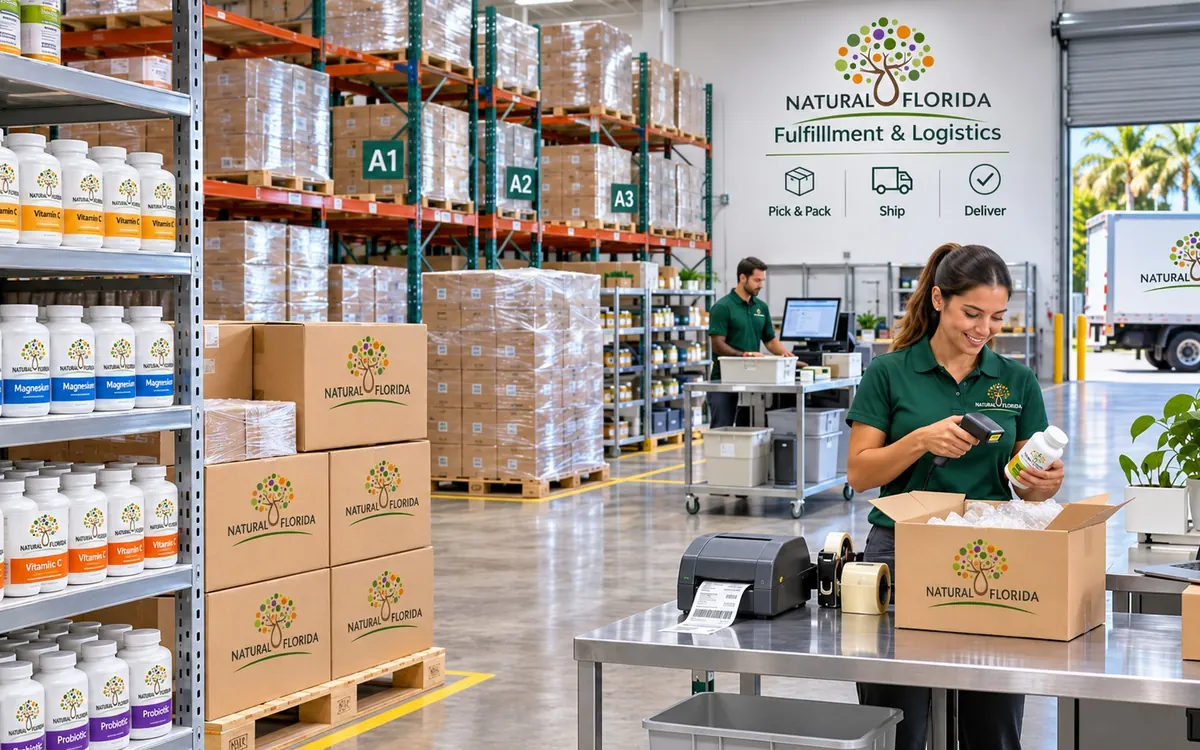
- Shipping cartons (master cases) hold a set number of bottles and must protect them in transit. Label them with the product, count, lot and best-by date.
- Pallets for larger orders, wrapped and labeled for the receiving warehouse.
Packaging for Amazon FBA
Amazon has its own preparation and labeling requirements, and they change from time to time. Typical points include unit barcodes (manufacturer barcodes or Amazon labels), case labels, carton weight and size limits, and, for supplements, policies on labels and documentation. Check the current requirements in Seller Central before you finalize packaging. Our guide to Amazon private label supplements covers what your manufacturer can prepare.
Packaging cost: what drives it
Packaging is often a large part of the cost per unit. Typical drivers:
- Bottle material and size, and whether it is a stock or custom mold
- Cap type: child-resistant usually costs more than continuous thread
- Label vs full sleeve, and print effects
- Desiccants and cotton
- Retail boxes
- Order quantity, since components are cheaper in larger volumes
Stock components are the fastest and most economical way to launch. Custom molds and unusual shapes add tooling cost and time. See supplement manufacturing cost for how packaging fits the full quote.
Sustainability options
Brands increasingly ask for lighter or more sustainable packaging. Options include post-consumer recycled (PCR) plastic bottles, lighter-weight bottles and refill pouches. Make sure any change still protects the product; test it before switching. Any environmental claim on the pack must be accurate and supported, under the FTC's Green Guides, and claims about the product's health effects must follow the FTC Health Products Compliance Guidance.
Packaging decision checklist
- Bottle material suits the formula's moisture and light sensitivity
- Bottle size fits the count with sensible headspace
- Cap matches the neck finish; child-resistant if required
- Induction seal and tamper statement included
- Desiccant decision made for the formula and climate
- Label or sleeve sized from the actual bottle
- Space for lot number and best-by date
- Label meets FDA requirements
- Case pack and carton labels planned
- Amazon FBA or retailer requirements checked
Packaging at Natural Florida
Natural Florida bottles and labels capsules and tablets in house. We supply bottles, caps, induction seals and desiccants, bottle in your chosen count, apply your labels or shrink sleeves, and code each bottle with its lot number and best-by date, all under cGMP practices under 21 CFR Part 111. We help you choose components for your formula, ship to your warehouse, your 3PL or Amazon FBA, and reply within one business day. See our private label supplements service, read how we handle bottling, labeling and packaging for your brand, or send your packaging ideas through the quote form.
Frequently asked questions
What is the best bottle for supplements?
For most capsules and tablets, an HDPE bottle with an induction seal is a reliable, cost-effective choice. PET shows the product and amber glass gives a premium look and strong protection.
Do supplements need an induction seal?
It is not legally required for every product, but it is standard practice: it shows tampering and protects against moisture and oxygen.
Should I add a desiccant to my supplement bottle?
If your formula is sensitive to moisture or will ship through hot, humid areas, a desiccant helps protect it. Your manufacturer can advise based on the ingredients.
Who supplies supplement packaging?
Supplement packaging manufacturers make bottles, caps and labels, and many contract manufacturers source and fill them for you, so you deal with one supplier.