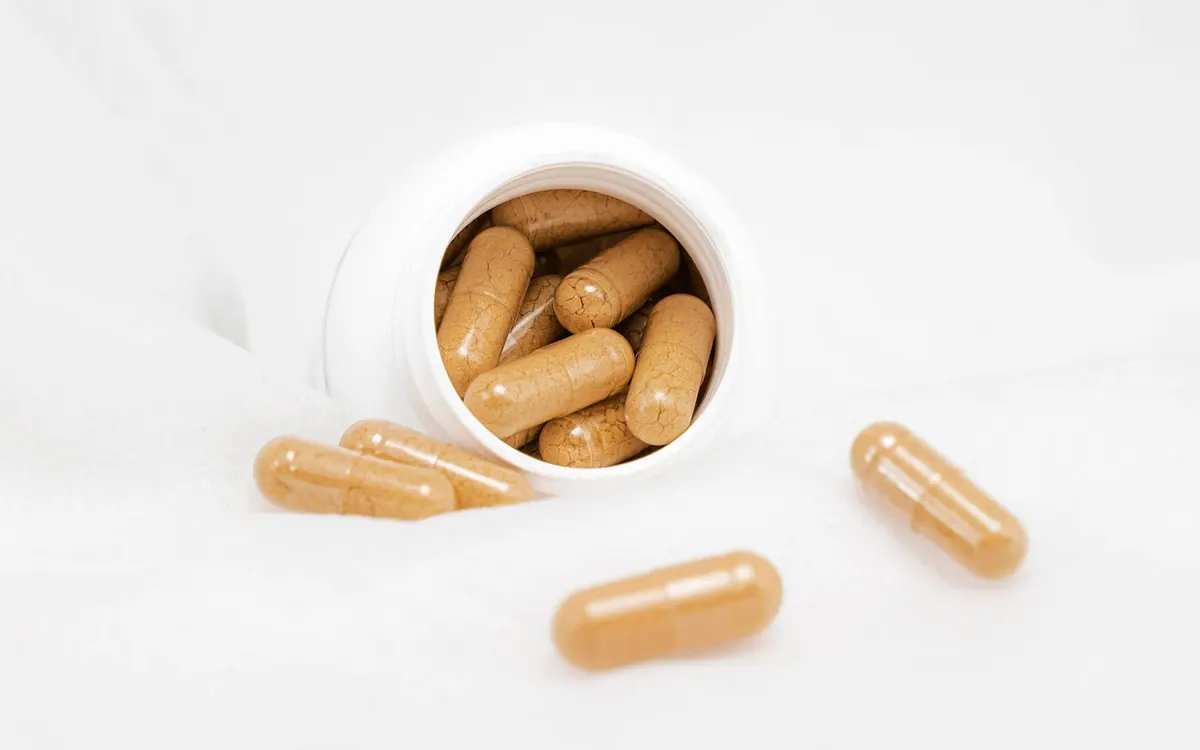


White label supplements are ready-made products, formulated and produced by a manufacturer, that you sell under your own brand with little or no change to the formula. You choose a product from a catalog, add your label, and order. White label is the fastest and simplest way to put a supplement on the market, which makes it a good fit for testing a niche, adding a product to an existing audience or launching on a tight budget. The trade-off is that other brands may sell the same formula.
How white label works
A white label supplement manufacturer keeps a range of standard formulas: common vitamins, minerals, botanicals and popular blends. The formula, capsule or tablet, and often the bottle are fixed. Your input is mostly the brand: name, label design, sometimes bottle color or count.
A typical white label project looks like this:
- Browse the manufacturer's catalog and request specifications for the products you like.
- Order samples and check appearance, smell, size and taste.
- Prepare label artwork using the manufacturer's Supplement Facts information.
- Confirm quantity and packaging, then place the order.
- Receive finished, labeled bottles, or blank bottles to label yourself if that is the agreement.
Because the product already exists, there is no formulation stage, and sampling usually takes one round.
White label vs private label
People use the terms loosely, and some manufacturers use them interchangeably. In this guide we use them this way:
| White label | Private label | |
|---|---|---|
| Formula | Fixed, shared with other brands | Base formula, adjustable |
| Changes you can make | Label, sometimes count or bottle | Doses, ingredient forms, capsule type, count, packaging |
| Speed | Fastest | Fast |
| Minimums | Lowest | Low |
| Differentiation | Brand and marketing only | Brand plus product |
| Best for | Testing, add-on products, tight budgets | Most new brands with a clear customer |
For the full comparison including custom formulas, read private label vs white label vs custom supplements.
When white label makes sense
White label is a strong choice when:
- You already have an audience. A coach, clinic, gym, creator or retailer whose customers trust them can sell a standard product under their own name. The trust is in the brand, not in a unique formula.
- You want to test demand. A white label run tells you whether a niche sells before you invest in development.
- You need a supporting product. A brand known for one hero product can add a basic multivitamin or magnesium to round out the range.
- Speed matters more than uniqueness. For a seasonal opportunity or an event, a ready-made product is the only realistic option.
When white label is the wrong choice
White label works less well when:
- You sell mostly through search and marketplaces. Shoppers compare labels side by side. If yours matches ten others, the cheapest one wins.
- You want a defensible product. A formula anyone can buy is not an asset you own.
- Your customers need something specific. A particular dose, a vegan capsule or a cleaner ingredient list may not exist in the catalog.
In those cases, private label, with a few meaningful changes, is usually the better starting point. Our private label supplements guide explains how that works.
What to check before you relabel
Your name on the label makes you responsible for the product, even though you did not formulate it. Before you order, check:
- The manufacturer follows the FDA cGMP rule, 21 CFR Part 111, and can show documentation
- Each lot comes with a certificate of analysis, and you know what it covers
- The full specification: ingredient forms, amounts per serving, other ingredients, capsule or tablet type
- Allergen information for every ingredient, including excipients
- Shelf life and storage conditions, and how the best-by date was set
- The Supplement Facts information matches the actual formula
- Any claims you plan to make are supported and use structure/function language
- What happens if the manufacturer changes or discontinues the formula
The last point is easy to miss. With white label, the manufacturer controls the formula. If an ingredient becomes unavailable and the formula changes, your label may need to change too. Ask to be told in advance.
Labeling white label vitamins and supplements
White label vitamins and supplements follow the same FDA labeling rules as any other supplement. Your label must include:
- A statement of identity that includes "dietary supplement" or a term describing the product, such as "Vitamin D3 dietary supplement"
- Net quantity of contents
- A Supplement Facts panel in the format required by 21 CFR 101.36
- Other ingredients, in descending order by weight
- Major food allergens, declared as required
- The name and place of business of the manufacturer, packer or distributor, for example "Distributed by Your Brand LLC"
- A domestic address or phone number for adverse event reports
If you make a structure/function claim, you also need the FDA disclaimer and must notify the FDA within 30 days of marketing, as set out in 21 CFR 101.93. The FDA Dietary Supplement Labeling Guide is the clearest free reference, and our article on supplement label requirements walks through each element.
Cost and minimums
White label usually has the lowest entry cost of any model because there is no development and the manufacturer may produce the formula for many brands at once. Minimums are often low. The unit price, however, is less flexible: you cannot remove an expensive ingredient or change the capsule count to hit a target price.
When you compare offers, check whether the price includes the label, application of the label, a certificate of analysis and shipping. Some white label offers ship blank bottles and leave labeling to you, which adds work and cost. For the main cost drivers, see supplement manufacturing cost.
Marketing a white label product honestly
The formula is shared, so the brand has to carry the product. That does not mean exaggerating. Supplement advertising must be truthful and backed by evidence, as the FTC sets out in its Health Products Compliance Guidance, and dietary supplements cannot claim to treat or prevent disease. Ways to stand out honestly:
- Explain why you chose this product for your customers.
- Bundle it with useful education, routines or guidance from your expertise.
- Offer excellent service, simple reorders and subscriptions.
- Be transparent about ingredients, doses and testing.
Moving from white label to private label
Many brands start with white label, learn what their customers want, then move to private label or custom formulas for their best sellers. Plan for that from the start:
- Keep your sales data by product and by channel.
- Read every review and customer question for clues about doses, capsule size or flavor.
- Ask your manufacturer early which changes are possible and at what quantity.
- Keep your brand name and label design flexible enough to carry a new version.
Switching can be as small as changing the dose of one ingredient or moving to vegetable capsules, and it gives you a product that is yours.
White label and private label at Natural Florida
Natural Florida makes capsules and tablets in Hollywood, Florida, following cGMP practices under 21 CFR Part 111. Most brands that come to us asking for white label end up with a light private label version: they start from one of our established formulas and adjust a dose, the capsule type or the bottle count, with a low minimum first run. We help prepare the Supplement Facts panel, review the label, and test every batch before release. Learn more about our private label and white label supplement options, or tell us what you would like to sell through the quote form. We reply within one business day. If you already know the formula you want, see how our private label service works step by step.
Frequently asked questions
What are white label supplements?
Ready-made supplement products, formulated and produced by a manufacturer, that you sell under your own brand with little or no change to the formula.
What is the difference between white label and private label supplements?
White label usually means a fixed formula shared by several brands. Private label usually means a base formula you can adjust, such as doses, capsule type or bottle count. Manufacturers use the terms differently, so ask what you can change.
Are white label supplements legal to sell?
Yes, as long as they are made under the FDA cGMP rule, labeled correctly and marketed with truthful claims. The brand owner is responsible for the product, so check the documentation.
Can I sell white label supplements on Amazon?
Yes, but Amazon has its own requirements for dietary supplements, including testing and documentation. See our guide on selling supplements on Amazon.